The New Delhi Declaration: A Fragile Peace in the 2026 Digital Cold War.
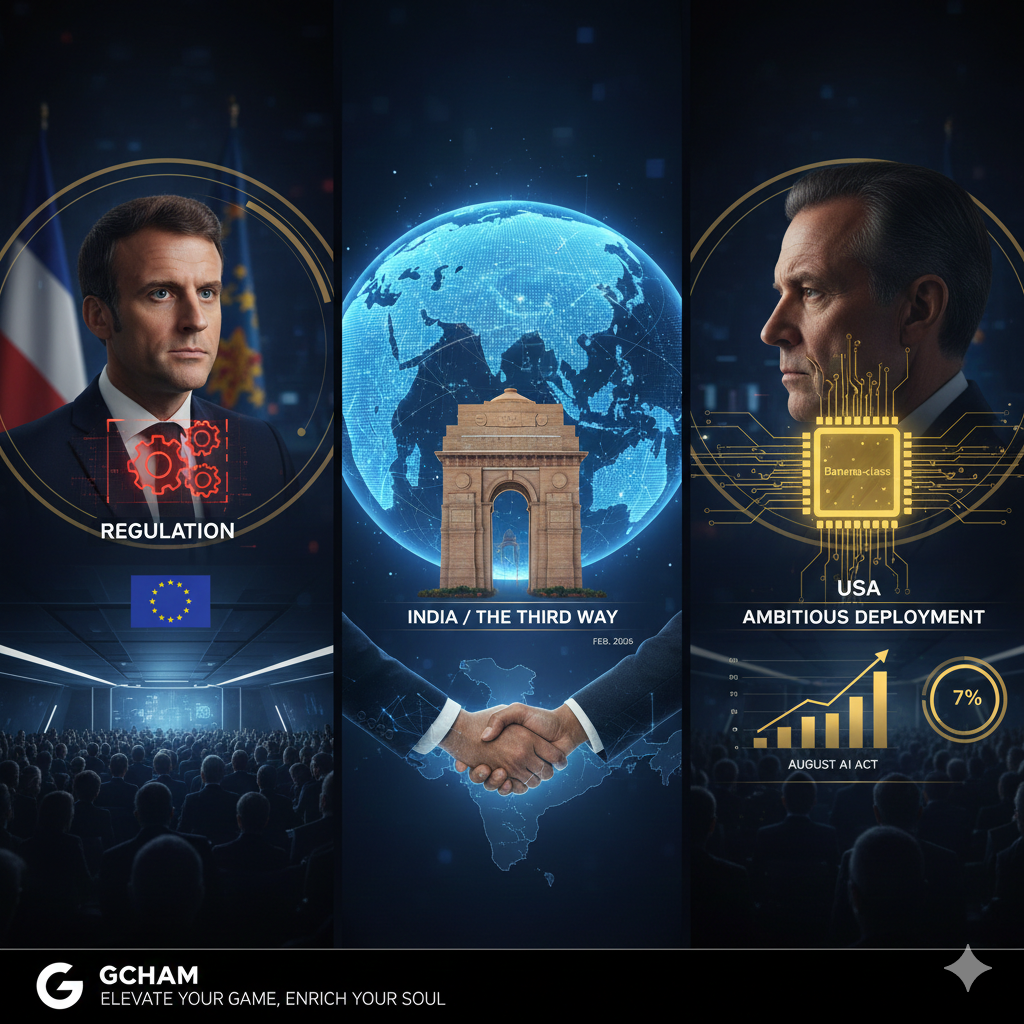
The Breakthrough in India
The India AI Impact Summit 2026 concluded today with 91 nations and organizations—representing the G20 and the core of the Global South—signing the “New Delhi Declaration.” In a rare moment of alignment, the United States and China joined hands with the EU to pledge a “Human-Centric” AI framework. For the GCHAM audience, this signals a tactical “Pax Silica” (Silicon Peace), but one that rests on the thinnest of diplomatic ice.
The ‘Regulatory Heart’: Macron’s 2026 G7 Vision
French President Emmanuel Macron used the Delhi stage to preview France’s 2026 G7 Presidency. His “Regulatory Heart” strategy is no longer just a European ideal; it’s a global sales pitch.
- The ‘Digital Majority’ at 15: Macron urged Prime Minister Modi and G7 leaders to adopt France’s landmark ban on social media for children under 15. This “Coalition of the Willing” aims to move beyond tech ethics into “Civilizational Safety.”
- China’s Tactical Pivot: Beijing’s signature on the declaration is viewed by analysts as tactical rather than philosophical. By endorsing “Sarvajan Hitaya” (Welfare for All), China is positioning itself as the champion of the Global South, subtly contrasting itself with US “Data Hegemony.”
The August 2nd Countdown: A Binary Choice for US Tech
While the New Delhi vibes are positive, the real battlefield remains the EU AI Act. On August 2, 2026, the Act’s most stringent “High-Risk” enforcement clauses come alive.
- The Stakes: US firms currently operating in France and Germany will face a binary choice: comply with total algorithmic transparency or face fines of up to 7% of global turnover.
- The Conflict: A leaked memo from the US State Department suggests that Washington may view these enforcement actions as a “non-tariff trade barrier,” potentially triggering retaliatory “Pax Silica” export controls on 2nm chips.
GCHAM Geopolitical Verdict: The ‘Delhi Buffer’
The New Delhi Declaration is a “Strategic Buffer.” It buys the world six months of cooperation before the regulatory collision of August 2026.
Mogul Signal: Watch the India-France hardware corridor. If Bangalore and Paris begin co-developing “Sovereignty Chips,” the US lead in global hardware will face its first legitimate structural challenge.